
The Invisible Pressure Beneath the Snow
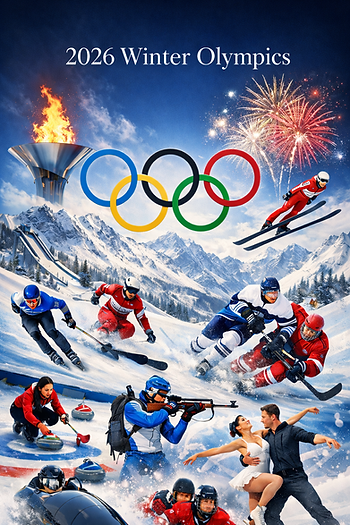
The Winter Olympics dazzle us with spectacle — precision, speed, national pride carved into ice and mountain. We see athletes suspended midair against alpine horizons, skis cutting clean lines into powder that looks timeless.
But beneath the snow lies something we do not see.
An invisible tension is building.
This year’s Winter Games in northern Italy unfold against a backdrop that is no longer theoretical. Mountain regions across the globe are experiencing reduced snowfall, shorter winters, and increasingly volatile weather patterns. A recent report from the World Economic Forum warns that by 2040, only a small number of countries may remain climatically viable to host the Winter Olympics and Paralympics.
That is not a headline about sport.
It is a headline about systems stress.
The Snow That Isn’t Snow
Artificial snow has become a standard feature of the modern Winter Games. Snowmaking cannons hum across mountain slopes, converting water and energy into the appearance of winter.
On the surface, this seems like adaptation.
But artificial snow is not neutral.
It requires:
Massive water withdrawals
High energy consumption
Transportation infrastructure
Storage and redistribution systems
Precise temperature windows to function
In other words, we are engineering winter.
And engineering always comes at a cost.
Artificial snow is denser and icier than natural snowfall. For athletes, this changes edge control, landing dynamics, and muscle fatigue. Training regimens must adjust. Injury risks can shift. Conditions become less organic, more mechanical.
The public sees white slopes.
Athletes feel the difference.
The Cost Curve No One Wants to Discuss
There is also a financial layer to this invisible pressure.
Snowmaking is expensive. Insurance premiums for winter events are rising. Host cities must now factor in climate volatility when bidding — a variable that cannot be fully controlled.
The Winter Olympics were once awarded primarily on infrastructure and political readiness.
Now, climate resilience sits quietly at the table.
Behind every slope lies:
A water budget
An energy calculation
A risk assessment model
The Games are becoming a stress test for planetary limits.
The Paralympic Timing Dilemma
There is another, subtler dimension.
The Paralympic Winter Games are traditionally held after the Olympics, later in the season. As winters shorten and temperatures rise, this timing increases exposure to unstable conditions.
Safety and fairness are no longer seasonal assumptions — they are climate-dependent variables.
And that changes everything.
What the Winter Games Reveal
The Winter Olympics are not failing.
They are revealing.
They reveal that:
Climate risk is operational.
Adaptation is expensive.
Technological substitution cannot fully replicate natural systems.
Even global institutions must adjust to ecological boundaries.
The invisible tension beneath the snow mirrors what many industries are quietly experiencing — water utilities, agriculture, insurance, tourism, energy grids.
We are building increasingly sophisticated systems to maintain appearances of stability while foundational conditions shift.
That is not collapse.
But it is pressure.
The Question Ahead
If only a handful of countries remain capable of hosting winter sports by 2040, we are witnessing more than a sporting evolution.
We are witnessing the narrowing of climatic possibilities.
The question is not whether the Games will continue.
The question is how many other sectors are standing on artificial snow — functional for now, but dependent on energy-intensive compensation rather than regenerative balance.
The slopes are still white.
The flags still wave.
But beneath the surface, something unseen is tightening.
And that invisible pressure may be the most important signal of all.


Comments